

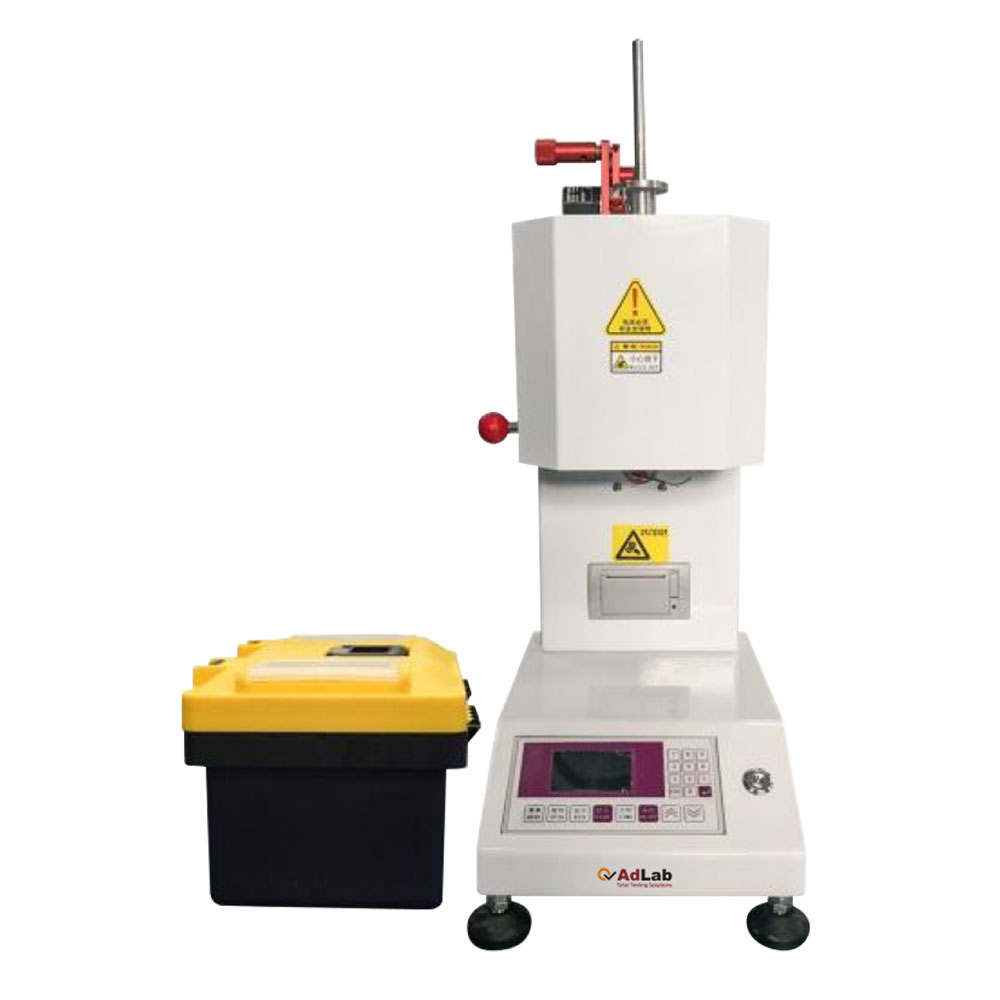
Melt Flow Index Tester
Availability: In Stock
Brand: AdLab
Model: ADL-MF400
Origin: Europe

Introduction
Melt Flow Index Tester is used to determine the MFR&MVR value of the melt flow rate through the standard die every 10 minutes when various plastics and gums pass through a certain temperature and load in a viscous flow state. It is suitble for melting high temperature polycarbonate, polysulfoxide, fluorine plastics, nylon and other engineering plastics. Also, it is appropriate for the polyformaldehyde, polystrene, polypropylene, ABS resin polyformaldehyde, polycarbonate resin and other low temperature plastic melting test. The machine is widely used in plastic production, plastic products, petrochemical and other industries as well as related universities, scientific research units and commodity inspection departments.
Test Standard
GB/T3682-2018 Determination of melt flow rate and melt volume flow rate for thermoplastics
ISO1133: 1997 Determination of melt mass flow rate MFR and melt volume flow rate MVR for thermoplastics
ASTM D1238 Standard test method for determination of flow rate of thermoplastics melt by extruded plastimeters
Product Advantages
- The heating cylinder is made up of 304 stainless steel or alloy, for the reason that in high temperature metal material is easily oxidation rust while the melting flow index tester usually performs long-time work at high temperature
- The melting flow index rate instrument is equipped with dual sensor configuration to get precise tempera-ture control and better temperature gradient so that the instrument can work longer.
- According to the national standard, function that four minute countdown after feeding is added in the machine.
- The last test conditions can be directly displayed after boot-strap to avoid users resetting test parameters each time, reducing the workload of the operators.
- The maximum temperature can be up to 450~500°C (optional, special instructions when ordering).
- After long time test of strong corrosive plastic such as full fluorine plastic, the accuracy of the instrument is non-destructive.
- Meeting standards: ISO 1133, ASTM D1238, GB/T3682





Reviews
There are no reviews yet.